
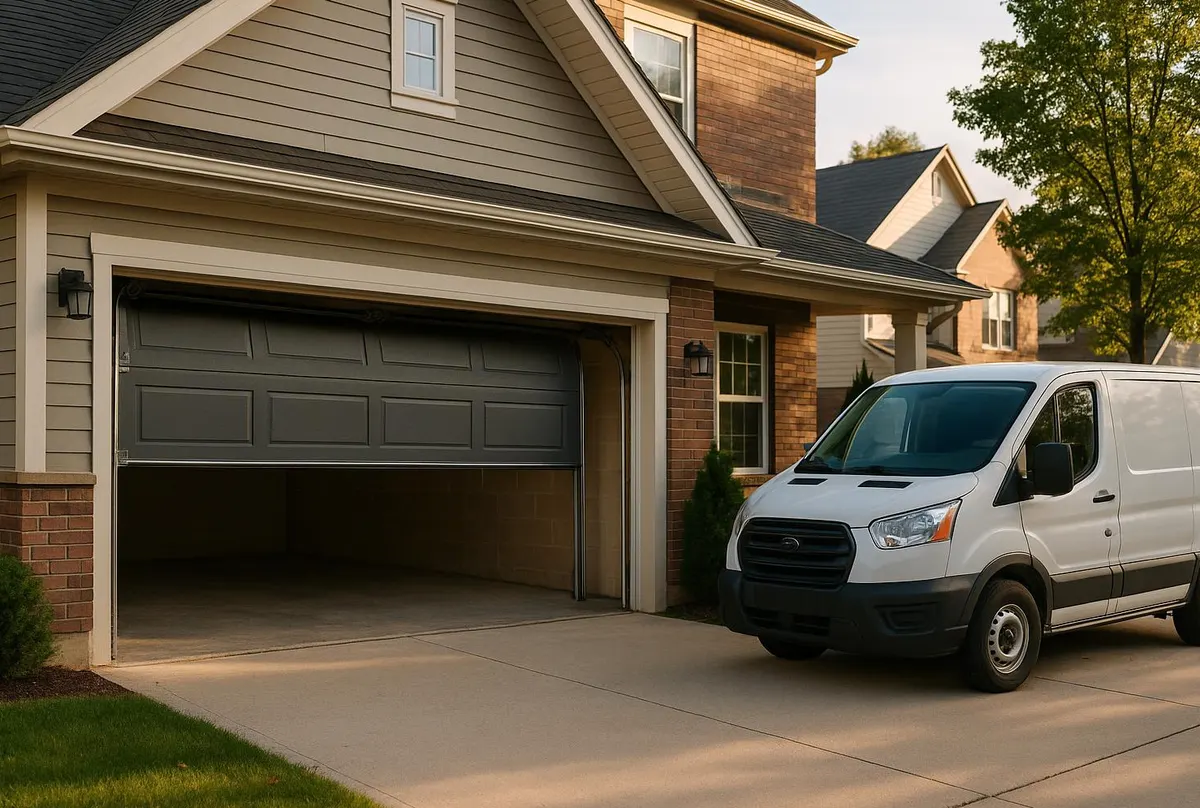
Rule of thumb: if you disconnect the opener and lift your garage door by hand, it should stay wherever you let go of it. If it drops, creeps, or shoots upward on its own, the door is unbalanced. The exceptions: a door that drifts down slowly over several seconds is usually fine, and a door that feels heavy but moves evenly isn't necessarily unbalanced — it might just be a heavier insulated or wood-look model doing what it's supposed to do.
What an Unbalanced Door Does to Your Opener
Garage door openers are built to move the door, not to hold its weight. That job belongs to the springs. When a spring loses tension — from age, from a big temperature swing, or from the cable that works with it starting to fray — the opener's motor quietly picks up the slack. You usually don't notice right away, because the door still opens and closes. But the motor is drawing more power every cycle, the gears and drive belt or chain are under more load, and the opener's internal force sensors start compensating by pushing harder than they should.
That compensation is the dangerous part. Many homeowners respond to a door that's struggling by cranking up the force setting instead of fixing the balance. The door starts moving again, but now the opener is strong enough to keep driving even if someone's hand or a pet is in the way. It's also strong enough to strip gears, snap a belt, or burn out the motor months or years before it should have worn out. An unbalanced door is one of the fastest ways to turn a $5 spring adjustment into a full opener replacement.
Tools You'll Need
- A sturdy step ladder
- Work gloves
- A flashlight
- Painter's tape or a marker (optional, for marking positions)
- A second person, if your door is heavier than average or you're not confident lifting it alone
How to Test the Balance Yourself
- Close the door completely. Start from a fully closed position so you're testing the door through its full range.
- Disconnect the opener. Pull the red emergency release cord hanging from the trolley. You'll hear or feel the door disengage from the opener arm. The door is now running on spring tension alone.
- Lift the door to waist height. Grip it by the bottom handle or edge, lift slowly, and let go once it's roughly halfway open.
- Watch what it does. A balanced door stays put or sinks down gradually over several seconds. An unbalanced door will either drop quickly or jump upward on its own — both are signs the springs are mismatched to the door's weight.
- Repeat at the quarter and three-quarter positions. Some doors are balanced in the middle of their travel but not near the top or bottom, especially if one spring is weaker than the other on a two-spring system.
- Do a visual check while you're up there. With the flashlight, look at both torsion springs for an uneven gap between coils, check the lift cables for fraying near the bottom bracket, and look at the tracks for any spot where they've pulled away from the wall or bent inward.
- Reconnect the opener by pulling the release cord again (or following your opener's reconnect instructions) and run the door through a normal open-close cycle to confirm everything still tracks smoothly.
Why This Matters More Here Than in Milder Climates
Long, hot summers followed by sudden severe storms put real stress on garage door hardware around Lakeway, Bee Cave, and the rest of the Hill Country. Metal springs and tracks expand and contract with big temperature swings, which gradually changes spring tension even on a door that's never been touched. High wind and hail events can rack a track out of true alignment without leaving obvious damage, and dust blowing in off dry ground works into rollers and hinges, adding friction that masks a balance problem until it's severe. Running this test in spring and again in early fall, before the heat or the storm season fully sets in, catches drift before it turns into a stuck or runaway door.
What's a DIY Job and What Isn't
Running the manual balance test, checking cables visually, and clearing debris from tracks and rollers are all safe for a homeowner to do. Adjusting spring tension is not. Torsion springs are wound under extreme force, and loosening or tightening them with the wrong tools, or without the winding bars sized for your specific spring, has caused serious injuries. If your test shows the door is unbalanced, that's your signal to stop and call a technician rather than reach for a wrench.
When to Call Lakeway Garage Door Specialists
If your door fails the lift test, drops or shoots up instead of holding position, or you spotted uneven spring coils or a frayed cable during the visual check, it's time to call in a professional. Our technicians handle spring replacement safely, with the right tools and tension gauges to match new springs to your door's actual weight, not just a generic size. We also offer preventive maintenance visits that include a full balance check, track alignment, and hardware inspection, which is the easiest way to catch a weak spring before it fails outright or quietly overworks your opener.
If you're in Lakeway, Bee Cave, Spicewood, Hudson Bend, Steiner Ranch, West Lake Hills, Lago Vista, or Dripping Springs and your garage door isn't holding its position the way it should, give Lakeway Garage Door Specialists a call. We'll run the diagnostics, tell you straight whether it's a spring issue or something else, and get your door back in balance before it costs you an opener.